Intersectionality in Educational Attainment Research: Frameworks, Methods, and Applications

Educational attainment research asks who completes secondary school, enters higher education, earns a degree, or gains access to advanced credentials. Intersectionality strengthens this work by examining how social identities and systems of power operate together rather than treating race and ethnicity, gender, or social class as isolated variables.
In the sociology of education, this perspective shifts attention from individual characteristics alone to the institutional settings and structural conditions that distribute opportunity unevenly. It also helps researchers recognize variation within broad categories such as women, racial minorities, working-class students, migrants, or disabled learners.
What Intersectionality Means in Educational Attainment Research
Intersectionality in educational attainment research examines how overlapping social positions and interconnected systems of power shape educational opportunities, experiences, and outcomes. It treats identity and inequality as relational, institutional, and context-dependent.
The concept is closely associated with Kimberlé Crenshaw’s work on legal discrimination, although its intellectual roots also extend through Black feminist scholarship and critical race theory. Applied to education, intersectionality asks how students experience schooling at the meeting point of several social locations, such as race and ethnicity, gender, social class, disability, migration background, and sexuality.
This does not mean that every study must include every possible identity category. A sound analysis identifies the dimensions most relevant to the research setting and explains why they matter. For example, a study of university access might examine how racialized admission practices interact with family income, gender expectations, and immigration status.
The central concern is structural inequality. Educational attainment is influenced by material resources, institutional decisions, cultural expectations, policy environments, and unequal exposure to opportunity. Students make choices, but those choices occur within patterned conditions that affect what options appear available and achievable.
Moving Beyond Single-Axis Explanations of Educational Inequality
Single-axis analyses study race, gender, or class separately, whereas intersectional analysis examines how these dimensions combine and produce distinct educational experiences. The main difference is analytical focus: intersectionality investigates relationships among systems of power rather than ranking one identity as the primary cause.
A study reporting that girls have higher degree completion rates than boys may conceal important differences by race, class, disability, or migration background. Similarly, an analysis of racial disparities may treat all students within a racial or ethnic group as having the same relationship to gender norms, household resources, language, or institutional treatment.
Intersectionality therefore draws attention to within-group variation. The educational pathway of a middle-class immigrant woman attending an elite university may differ sharply from that of a low-income immigrant woman navigating language barriers and insecure housing. Both may be counted under the same gender and migration categories, yet their access to institutional support is not equivalent.
Researchers should avoid assuming that intersecting disadvantages simply add together. A racial penalty, a gender penalty, and a class penalty may not produce a predictable combined effect. Their interaction can be weaker, stronger, or qualitatively different depending on school policy, historical context, and institutional culture.
Key Dimensions to Examine
Relevant dimensions of intersectionality include race and ethnicity, gender, social class, disability, migration background, sexuality, language, religion, age, and geography. Researchers should select dimensions according to the educational context and the mechanisms under investigation.
Race and ethnicity may shape attainment through racialization, segregation, teacher expectations, curriculum representation, disciplinary practices, and unequal access to experienced staff. Gender can influence subject selection, care responsibilities, safety, peer cultures, and institutional expectations. Social class affects housing stability, tutoring, digital access, time for study, transport, and familiarity with educational systems.
Disability introduces questions about accessibility, assessment accommodations, special education classification, and whether institutions define support as an entitlement or an exception. Migration background may intersect with language policy, citizenship, recognition of prior qualifications, and family knowledge of the education system. Sexuality can shape belonging, safety, disclosure, and participation where school climates are heteronormative or hostile.
These categories are not interchangeable. Identity categories are social processes, not merely biological or administrative labels. Their significance changes across countries, institutions, historical periods, and educational stages. A useful research design states how each category is defined, who applies the label, and what institutional consequences follow.
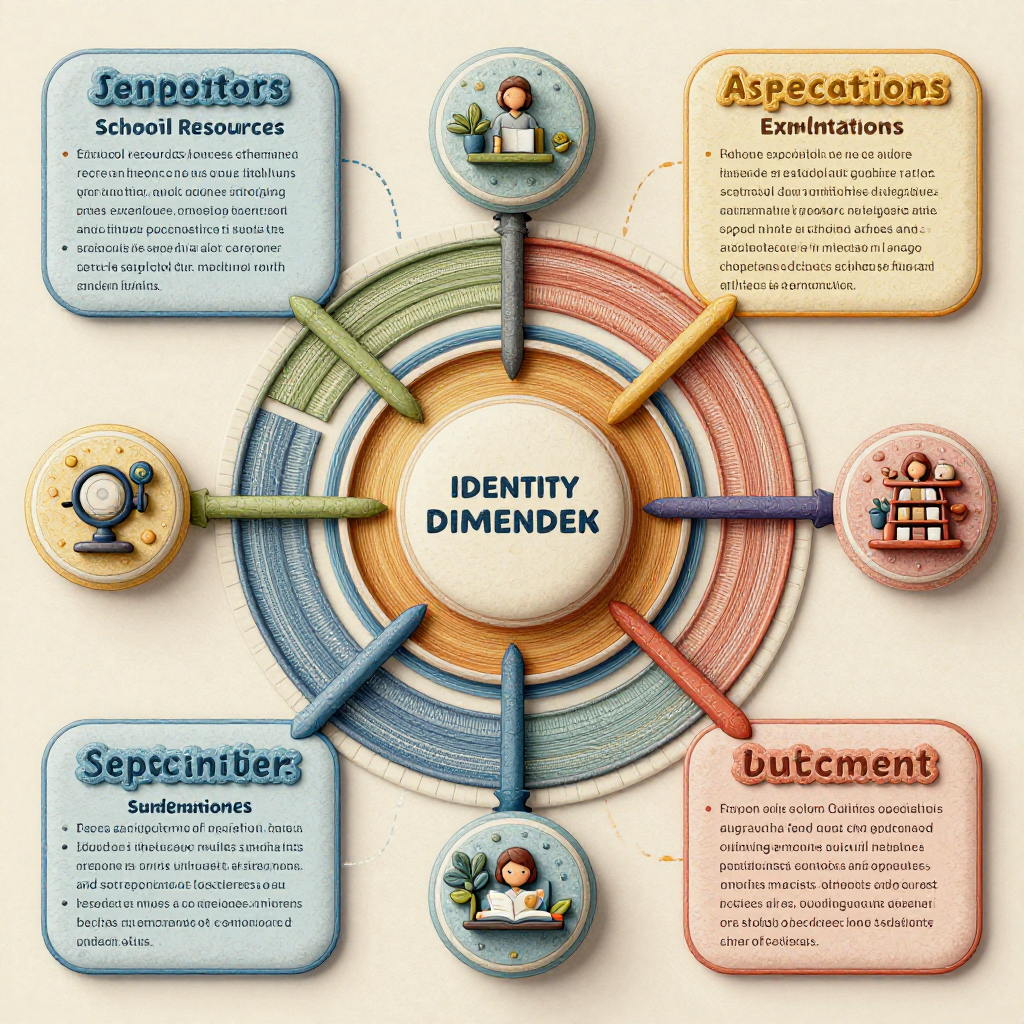
Institutions, Structures, and Educational Pathways
Educational institutions shape intersectional attainment through rules, routines, classifications, and resource distributions that affect students differently. Schools and universities can reproduce inequality through ordinary processes such as tracking, assessment, admissions, advising, and discipline.
At the school level, ability grouping and academic tracking may direct students toward different curricula and postsecondary options. Teacher recommendations can influence placement, while expectations may reflect racialized, gendered, classed, or ableist assumptions. Families also matter, but family influence is mediated by employment schedules, income, neighborhood conditions, language access, and relationships with institutions.
Higher education systems introduce additional filters. Application fees, standardized tests, selective admissions, unpaid internships, financial aid rules, and uneven advising can produce unequal transitions from secondary school to college. Once enrolled, students may encounter different experiences in large public universities, elite institutions, community colleges, or vocational programs.
Policy environments connect these local processes to wider structures. Funding formulas, school choice, immigration rules, disability legislation, student finance, and accountability systems shape the resources and risks attached to educational pathways. A student’s attainment should therefore be analyzed across time: early schooling, subject choice, transitions, persistence, completion, and the value of the credential obtained.
The strongest studies connect individual experience with institutional mechanism. An interview about discouraging guidance becomes more analytically powerful when linked to counselor caseloads, admissions policy, tracking rules, or resource differences between schools.
Research Designs and Methods
Qualitative, quantitative, and mixed-methods designs can all support intersectional educational attainment research. The appropriate choice depends on whether the study prioritizes lived experience, population patterns, institutional mechanisms, or the relationship among them.
Qualitative approaches
Interviews, focus groups, ethnography, document analysis, and institutional case studies reveal how students interpret their positions and navigate educational settings. These methods can show how a policy is experienced differently by students who occupy similar formal categories but have unequal resources or distinct histories.
Quantitative approaches
Statistical analysis can estimate differences in enrollment, persistence, completion, grades, or degree level across intersecting groups. Researchers may use interaction terms, stratified analysis, multilevel models, latent class approaches, or descriptive cross-tabulations. The method should match the question. An interaction coefficient alone cannot explain the institutional process behind a pattern.
Mixed-methods designs
Mixed methods combine population-level evidence with contextual explanation. For instance, quantitative data might identify lower completion among low-income students from a particular racialized group, while interviews and school records examine advising, work obligations, financial aid, and experiences of belonging.
Researchers should define categories carefully and report how they were created. Small subgroup samples may require confidence intervals, sensitivity analyses, aggregation decisions, or a decision to use qualitative evidence rather than unstable estimates. Transparency is more valuable than forcing every intersection into a statistical model.
Common Challenges and Interpretive Principles
Intersectional analysis faces practical and conceptual limits, including small samples, unstable categories, overly additive models, and causal overreach. These problems can be reduced through explicit theory, careful measurement, and attention to institutional context.
- Overly additive models: Adding separate race, gender, and class variables may conceal interaction and power. Specify the mechanism being tested and examine whether the combined pattern differs from single-axis expectations.
- Small subgroup samples: Detailed categories can produce imprecise estimates. Report uncertainty, avoid exaggerated conclusions, and consider purposive qualitative sampling or broader institutional comparisons.
- Fixed category assumptions: Administrative labels may change across settings and may not reflect self-identification. Explain who defined the category and what social process it represents.
- Causal overreach: A statistical association does not prove that identity itself caused an outcome. Separate identity markers from the discrimination, resources, policies, or expectations associated with them.
- Individualizing inequality: Focusing only on resilience or family behavior can obscure school funding, labor markets, admissions systems, and policy constraints. Trace the institutional chain connecting experience to attainment.
Interpretation also requires reflexivity. Researchers should consider how their sampling choices, disciplinary assumptions, and terminology shape what becomes visible. Intersectionality is a framework for analyzing power, not a requirement to produce the largest possible number of demographic comparisons.
Building Stronger Intersectional Studies of Educational Attainment
Strong intersectional studies begin with a context-specific question, identify the relevant power relations, and connect evidence across levels. They treat categories as analytically meaningful without treating students as homogeneous representatives of those categories.
- Start with a mechanism. Ask how a particular process, such as tracking, financial aid, language policy, or admissions, may affect differently positioned students.
- Define the educational outcome. Distinguish attainment measures such as enrollment, persistence, completion, credential level, grades, and postgraduation progression.
- Map the intersection. Identify the social positions and institutions relevant to the setting rather than applying a universal checklist.
- Choose evidence strategically. Combine administrative data, surveys, interviews, observation, policy documents, or comparative case studies when each adds a different kind of knowledge.
- Test variation within groups. Examine whether class, gender, disability, migration background, or geography changes experiences within a racial or ethnic category, and vice versa.
- Interpret patterns structurally. Explain how institutional rules and historical conditions produce unequal opportunities, while preserving attention to agency and resistance.
A useful final check is to ask whether the study explains three links: how social positions are produced, how institutions respond to those positions, and how those responses influence educational pathways. If one link is missing, the analysis may describe inequality without explaining it.
Frequently Asked Questions
What is intersectionality in educational research?
Intersectionality in educational research examines how overlapping social identities and systems of power shape students’ opportunities, experiences, and educational attainment within specific institutional contexts.
How does intersectionality differ from studying race, gender, or class separately?
It examines how these dimensions interact and how their combined significance changes across settings. This reveals differences within broad groups that single-axis analysis may conceal.
Which methods are suitable for intersectional educational attainment research?
Qualitative interviews, ethnography, policy analysis, quantitative interaction models, multilevel analysis, and mixed-methods designs can all be suitable when aligned with the research question and category definitions.
What are the main challenges of intersectional analysis?
Common challenges include small subgroup samples, unstable or imposed categories, overly additive statistical models, unclear causal claims, and insufficient attention to institutions and structural inequality.
How can researchers avoid treating identity categories as fixed or interchangeable?
Researchers should explain how categories were defined, examine who applies them, analyze their institutional consequences, and recognize that the meaning of an identity changes across historical and educational contexts.